
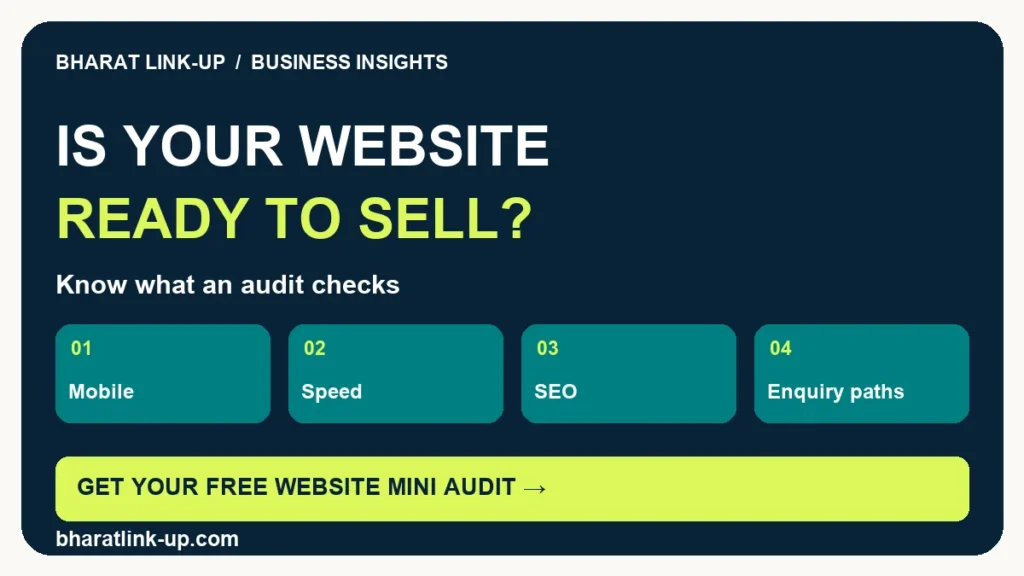

THE BUSINESS EDIT · 12 OCTOBER 2026
What Does a Website Audit Check? A Guide for Small Businesses
Understand what a website audit checks: mobile usability, speed, SEO basics, offer clarity and enquiry paths. Compare a free mini audit with a full review.
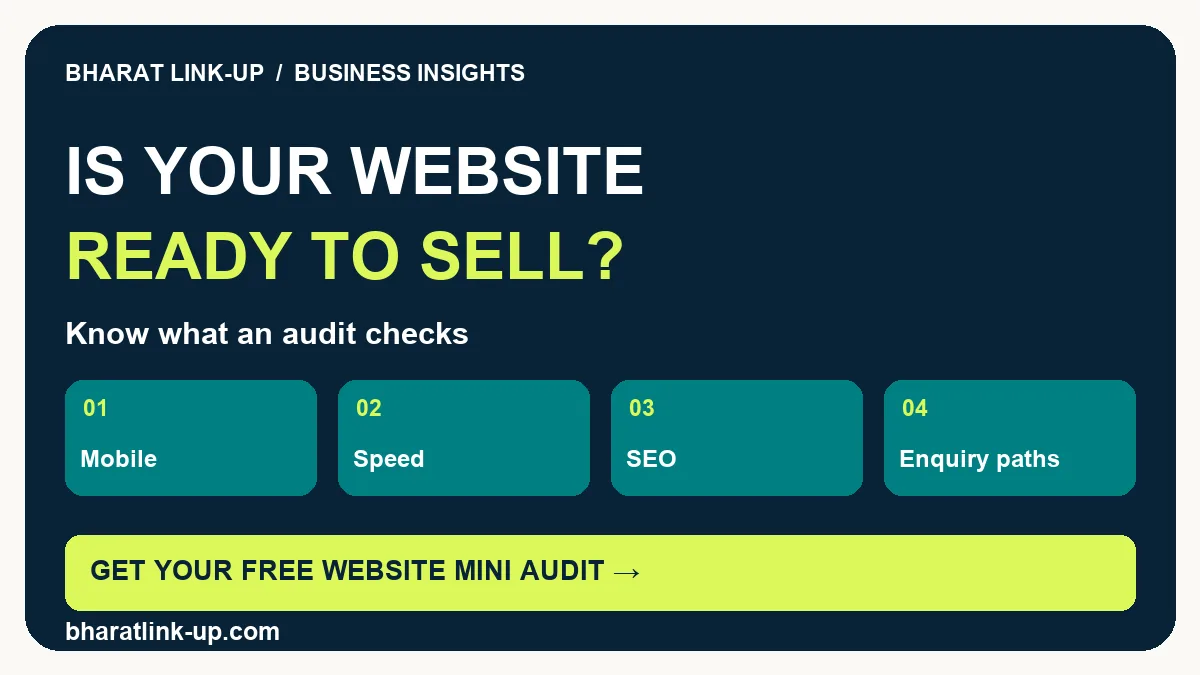
A website audit should give you a prioritised set of findings, evidence and next actions. It should not be a long list of scores without an explanation of what to fix. Before buying one, ask which pages are included, how findings are verified and whether implementation is part of the price.
Request a free mini audit of mobile usability, your main CTA and three fixes. Send your website for a free mini audit →
Offer clarity and customer journey
The reviewer checks whether a relevant visitor can understand the service, intended customer and next step. This includes the opening screen, service explanations, CTA labels and the route from useful content to an enquiry.
A useful finding names the page and obstacle. For example: an offer button leads to a general contact page with no scope explanation. The recommendation should explain what to change and why it matters to the customer.
Ask: will the report show the exact page, evidence and recommended action?
Mobile usability and accessibility basics
The audit should inspect readable text, navigation, touch targets, form labels, keyboard access and overlays. It should distinguish a real-device check from a desktop preview.
A basic audit does not automatically constitute a complete accessibility compliance assessment. Define the scope and limitations clearly, especially if specialised testing is required.
Ask: which devices or viewports are checked, and what remains outside scope?
Loading, responsiveness and visual stability
Performance checks can identify large images, delayed primary content, heavy scripts or layout movement. Results should include test conditions and distinguish laboratory tests from real-user data when available.
A single score is not a permanent property of the site. Network conditions, page changes and third-party resources can affect tests. Priorities should focus on meaningful customer obstacles rather than chasing a score in isolation.
Ask: does the report explain the cause and practical next step?
SEO basics and content discoverability
A scoped review may check titles, descriptions, heading structure, crawlability, indexing signals, canonical URLs, internal links and useful image descriptions. Search Console evidence requires access and should be distinguished from a public-page inspection.
An audit cannot guarantee first position or a fixed traffic increase. It should explain whether a page is technically available to search engines and whether its content fits a useful customer question.
Ask: which findings are verified and which require further access or research?
Enquiry forms and contact paths
Check buttons, phone or messaging links, form validation, confirmation and notification delivery. A complete submission test should use a clearly labelled test record and avoid treating it as a real lead.
The reviewer should verify actual behaviour, not assume a plugin works because it is installed. Agree on permission for test submissions and any limitations on administrative access.
Ask: will successful submission and delivery both be checked?
Measurement and prioritisation
The report should identify whether important outcomes are measured correctly. A form start is not a completed enquiry, and an owner test is not a customer. Where access permits, compare analytics with saved enquiry records.
Group recommendations by urgency and impact, with a clear owner or next step. Broken contact paths usually deserve attention before decorative refinements. Implementation effort and dependencies should be explained where known.
Ask: will I receive a written priority plan rather than only automated scores?
Understand the free and paid scope
Bharat Link-Up’s free mini audit reviews the homepage’s mobile usability, main CTA and three practical fixes. It is a limited first review, not a full-site security, accessibility or SEO certification.
The ₹999 full website audit covers agreed key pages, mobile UX, speed, SEO basics and enquiry paths, with a written prioritised plan. Page scope, access, timeline and payment are confirmed before work. Implementation is separate. Payment-provider setup is in progress; enquire for the currently available arrangement.
Ask: what exactly is included, when will it arrive and what costs extra?
Your practical next step
Before commissioning an audit, list the pages and problem you want investigated. Agree the scope, delivery method and timeline in writing. After delivery, address verified critical problems first and keep a record of changes and subsequent results.
For a posting framework, use our small-business content calendar. Review our service terms and refund policy before confirming paid work.
Frequently asked questions
Is a website audit worth paying for?
It can be useful when it answers a defined business problem and provides evidence-based priorities. Ask for scope, limitations and an example of the deliverable before purchasing.
Does a website audit include fixing the website?
Not necessarily. Bharat Link-Up’s full audit provides a written plan; implementation is separate. Confirm this distinction before paying.
What is included in the free mini audit?
A limited homepage review of mobile usability, the main CTA and three fixes. It does not replace a full-site review.
Can an audit guarantee Google rankings or sales?
No. It can identify obstacles and priorities. Rankings and sales depend on many factors beyond the audit.
How are cancellations and refunds handled?
Our published Terms and Conditions apply to paid services, including the audit. Review the linked refund and cancellation section before confirming work.
Related resources
Sources and editorial approach
These recommendations are practical editorial guidance, not a claim of measured conversion improvement. Examples are illustrative unless explicitly described otherwise. We used Nielsen Norman Group’s research on clear navigation cues, Google’s form design guidance and Core Web Vitals guidance for supporting principles. For search content, see Google’s people-first content guidance. No ranking or sales guarantee is offered.